
The Fed hiked, the BOJ hiked, and $16.6B in options to land the same week

Not financial advice. This is a research piece, not investment guidance; always do your own research before trading.
Where are we starting from?
Two hikes, 48 hours apart
On September 16 the Fed raised the federal funds target range 25 bps to 3.75% to 4.00%, its first hike since 2023, on a unanimous 12-0 vote. The updated dot plot lifted the year-end 2026 median to 4.1% to 4.4%, up from 3.6% to 4.1% previously. The next FOMC meeting is October 27-28.
Two days later the Bank of Japan hiked too, 25 bps to 1.25%, a 31-year high, on a 7-2 vote. That is notable on its own: the BOJ had been moving on a roughly six-month cadence, and this hike came just three months after June's. Headline inflation at 1.9% and real wages up for seven straight months gave the board its cover.
Together they mark the first time this cycle that both sides of the global carry trade have tightened in the same week.
The Fed and BOJ moving the same week matters more than either move alone.
A carry trade borrows where rates are low and invests where returns are higher. When the funding side (Japan) and the destination side (US risk assets) both tighten at once, the spread that made the trade attractive compresses from both directions, and leveraged positions get squeezed faster than either move alone would suggest.
The mechanism has a recent precedent. On August 5, 2024, a yen rally forced a carry-trade unwind that took the Nikkei down 20% over five sessions, including a single 12.4% day. Bitcoin fell 15%, Ethereum fell 20% and 10-year Treasury yields fell 55 bps over 11 trading days as the deleveraging spread globally. That history is precisely why a Fed hike and a BOJ hike landing 48 hours apart are being under the watchful market as one mechanism this week, rather than a scheduling coincidence.
Update, September 21: the carry trade has held, so far
As of Monday's open, USD/JPY is trading near 157 to 158, stabilizing above its 20-day EMA rather than falling the way the August 2024 precedent would suggest. The yen actually weakened after the BOJ's hike, the opposite of what a carry-trade unwind looks like.
The reason: the rate gap did not close. The BOJ hiked but stopped short of signaling more hikes aggressively, while the Fed's hawkish tone kept the dollar side of the differential just as wide. That was enough for the carry trade to hold into this week, though other described it as an inflection point, not yet unwound but fragile, rather than a resolved risk.
Crypto's own calendar added pressure on top.
The CLARITY Act, the market-structure bill the industry had been counting on, failed a Senate cloture vote 49-50 on September 15. It did not clear a simple majority, let alone the 60 needed to advance. No revote is scheduled, and the next realistic window is a push after November's midterms.
Money moved fast. Bitcoin ETFs lost $450.3M, and Ethereum ETFs lost $141.5M on September 15 alone, their worst single days since June 25 and January 30, respectively. Across the full week of September 14 to 18, combined crypto ETF flows were a net outflow of $70.7M, with ETH losses outweighing a $61M inflow into Solana products.
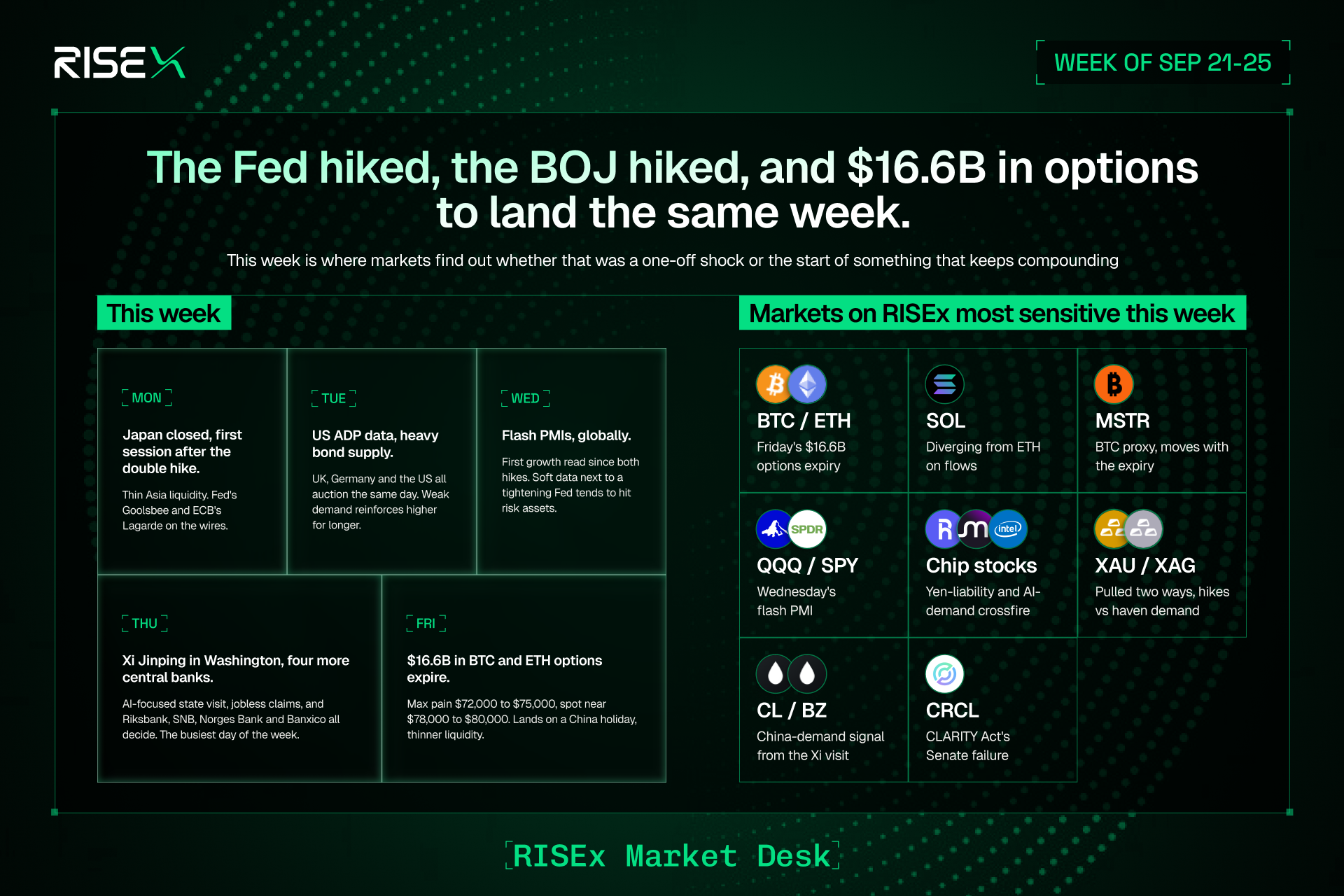
This week, day by day
Monday, September 21: Japan's market is closed for a holiday, so expect thinner liquidity in Asia hours. Fed's Goolsbee and ECB's Lagarde are on the wires.
Tuesday, September 22: US ADP employment data lands alongside a wall of bond supply out of the UK, Germany and the US. After a hawkish Fed, how these auctions clear is a real signal.
Wednesday, September 23: Flash PMIs land globally, in the US, the Eurozone, the UK and elsewhere, the first growth read since both hikes.
Thursday, September 24, the busiest day of the week: Chinese President Xi Jinping is in Washington for a state visit reported as centered on AI, a headline-driven event for anything with China or AI exposure. On top of that: US jobless claims, and four more central bank decisions the same day (Riksbank, SNB, Norges Bank and Banxico). It is a lot to digest in one session.
Friday, September 25, the big one for crypto: Roughly $16.6B in Bitcoin and Ethereum options expire on Deribit, $14.63B in BTC and $1.93B in ETH. Max pain for BTC sits at $72,000 to $75,000, well below the roughly $78,000 to $80,000 spot level heading in. That is a meaningful gap between where options are pinned and where price actually sits, and it lands on a day when China is out for its own holiday, meaning thinner liquidity and bigger potential swings.
What to watch on the RISEx
- BTC and ETH: the whole week funnels into Friday's expiry, on top of the ETF outflow trend and the regulatory overhang from the CLARITY Act's failure.
- SOL: quietly diverging from ETH on flows. Solana products pulled in $61M the same week ETH bled $141M, worth watching as a relative-strength story.
- MSTR: the BTC-proxy equity, which moves with whatever Friday's expiry does to spot.
- QQQ and SPY: direct exposure to Wednesday's PMIs and the market's ongoing repricing of higher for longer.
- Chip stocks (DRAM, MU, SNDK, INTC): flagged specifically in carry-trade-unwind coverage. Japan-linked chip supply chains sit at the intersection of AI-demand strength and yen-liability risk, and Thursday's Xi visit adds a second layer of AI-policy exposure.
- Gold and silver (XAU, XAG): pulled in two directions this week. Hawkish central banks argue for higher real yields, which is bad for metals, while carry-unwind risk and Xi-visit headline uncertainty argue for safe-haven demand. Do not expect a clean signal either way.
- Crude (CL, BZ): sensitive to any China-demand signal that comes out of the Xi visit.
- CRCL: the stablecoin and market-structure proxy most directly touched by the CLARITY Act's collapse.
FAQ
Why did the Fed and the Bank of Japan both hike in the same week?
The Fed raised its target range 25 bps to 3.75% to 4.00% on September 16, citing elevated inflation. The BOJ raised its policy rate 25 bps to 1.25% on September 18, citing inflation at 1.9% and seven straight months of real wage growth. The moves were separate decisions that landed close together, not a coordinated action.
Why does two central banks hiking together matter more than one hike alone?
It compresses the carry trade that funds leveraged positions from both sides at once, the low-rate funding side and the higher-return destination side. The August 2024 episode is the operating precedent: a 20% Nikkei drop over five sessions, a 15% BTC decline, a 20% ETH decline and a 55 bps drop in 10-year yields, all inside about two weeks.
What happened to the CLARITY Act?
It failed a Senate cloture vote 49-50 on September 15, falling short of even a simple majority. No revote is currently scheduled, and coverage points to a session after the midterms as the next realistic opportunity.
Did the yen carry trade unwind after the Fed and BOJ hiked in the same week?
Not as of Monday, September 21. USD/JPY is trading near 157 to 158, and the yen weakened rather than strengthened after the BOJ's hike, because the rate gap between the two central banks did not close. Other still called it an inflection point rather than a resolved risk.