
A chip and a chair: How partial liquidation keeps RISEx traders in the trade
RISEx implemented Partial liquidation on October 14, 2026: Liquidation that takes only what it must.

On October 22, a trader on RISEx opened a 10x short on Brent oil worth about $46K. For eight days, the trade went the wrong way. Oil kept climbing, and on October 30, the account fell below the maintenance margin and was liquidated.
Every trader knows what comes next. The position is sold near the worst price of the move, the fee comes out, and some time later the chart turns around without you. There is a line for it, mostly attributed to John Keynes:
The market can stay irrational longer than you can stay solvent.
This time, the ending was different.
The liquidation sold 7% of the position, leaving the remaining 93% open. Oil rolled over in the first days of November, and on November 3, the trader closed the remainder for a $350 profit. Previously, under full liquidation rules, the same trade would have ended about $3,463 down, with the whole position sold on October 30.
What is partial liquidation?
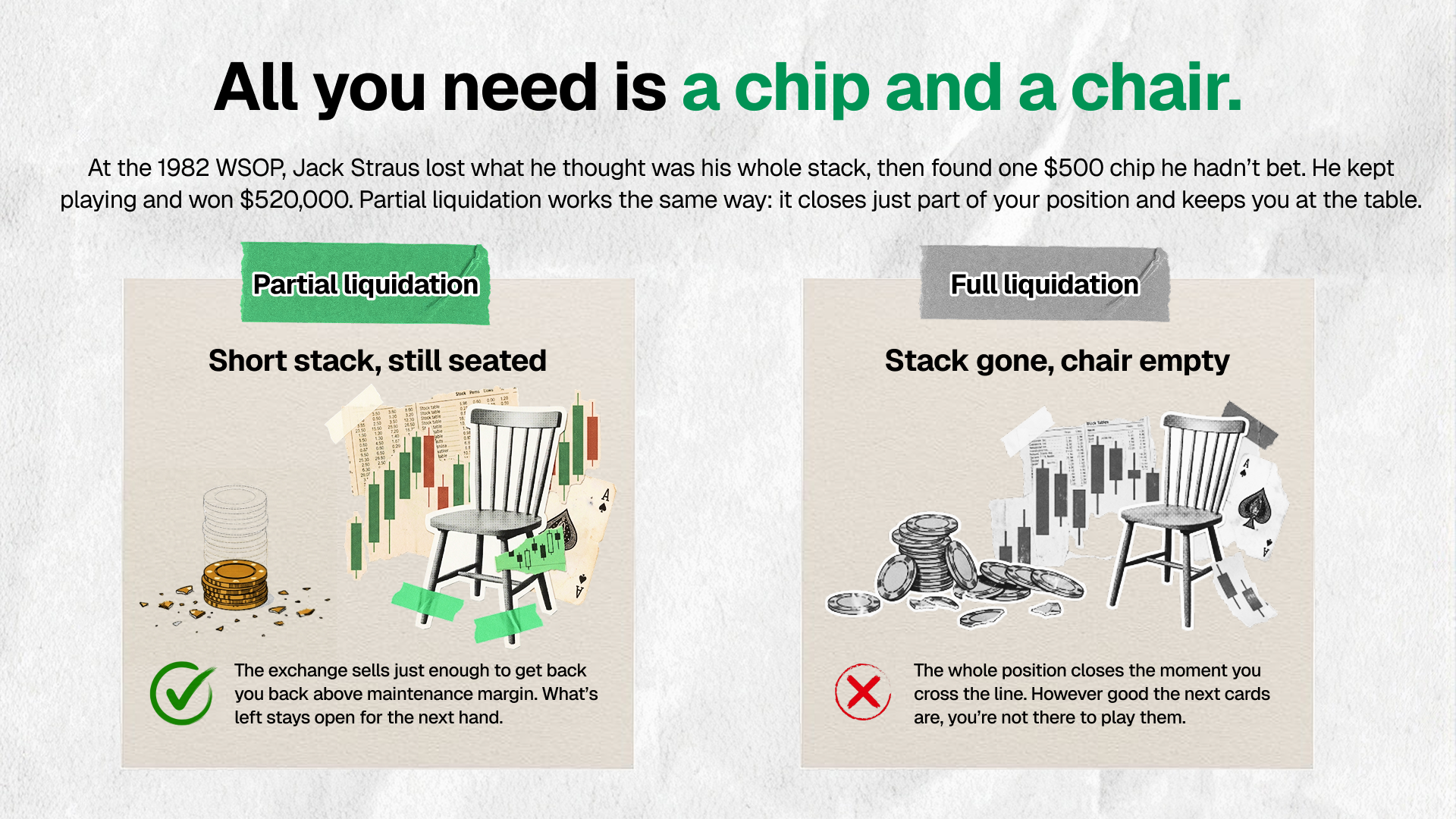
Partial liquidation closes only part of a leveraged position when an account falls below the maintenance margin. The exchange sells enough to bring the account back to safety and leaves the rest open. Full liquidation, the older approach, sells the entire position as soon as the account crosses that line.
RISEx introduced partial liquidation on October 14. The idea is not new, and most exchanges run some version of it. They differ in how big the cut is and who qualifies, which is where this piece comes in.
A chip and a chair

At the 1982 World Series of Poker main event, Jack Straus pushed what he thought was his whole stack into a pot and lost the hand. Then a single $500 chip turned up that he had not bet. He had never said "all in," so the chip was still his, and he could keep playing. He went on to win the tournament and $520,000.
Poker players have repeated the lesson ever since: all you need is a chip and a chair. A short stack still gets dealt the next hand. A player who leaves the table gets nothing, no matter how good the next cards are.
How does partial liquidation work on RISEx?
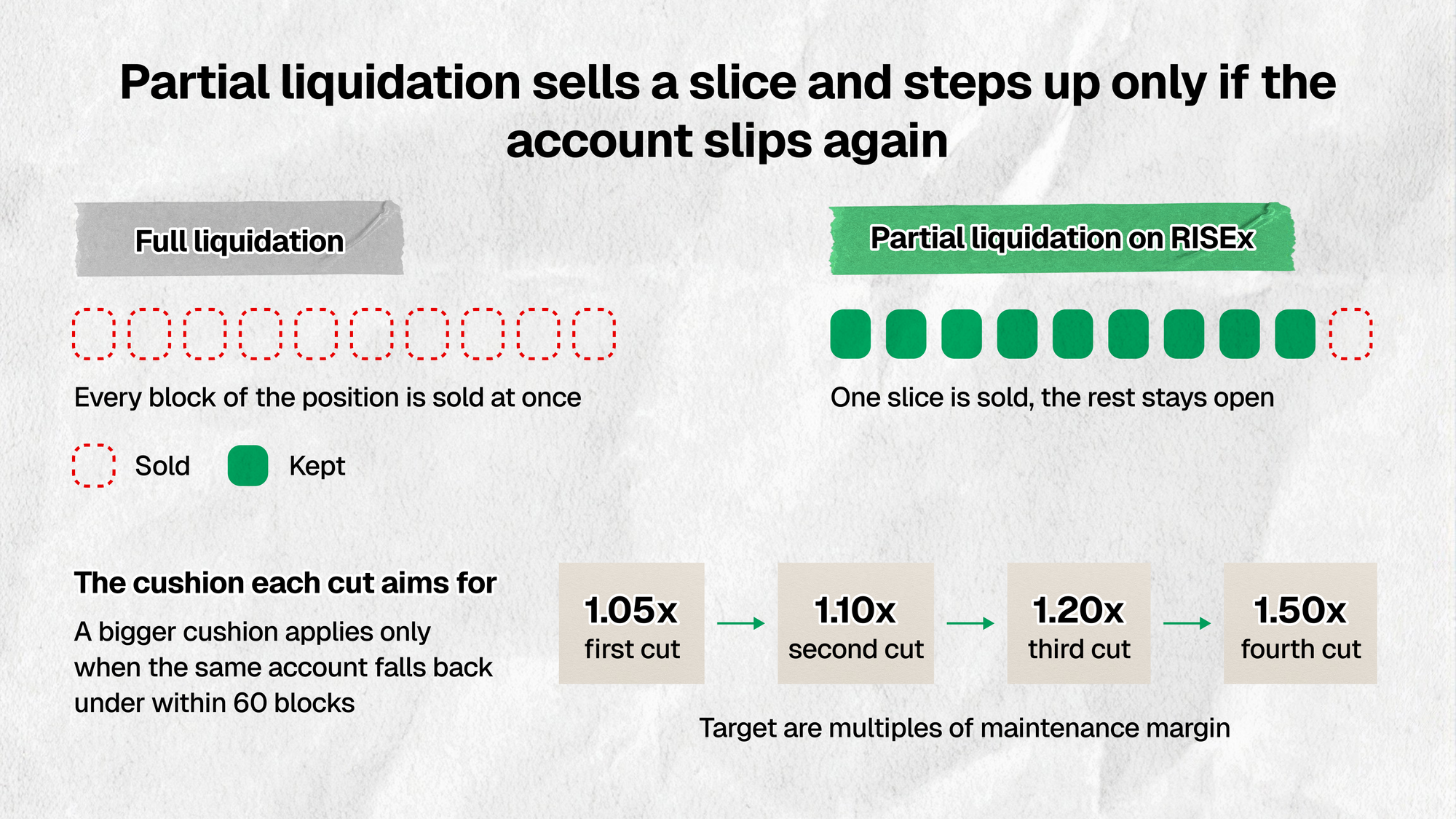
Picture your position as a tower of 100 blocks that has grown too tall to be safe. Full liquidation knocks the whole tower down. Partial liquidation lifts off the top few blocks, enough to steady it, and comes back for more only if the tower starts to wobble again.In practice, it runs in four steps.
- An account falls below the maintenance margin, the minimum collateral needed to keep its positions open.
- RISEx sells a slice of the position on the order book, sized to bring the account back to 1.05 times maintenance margin. That is a 5% cushion, and nothing beyond it is sold.
- If the market settles, the liquidation is over. In calmer weeks, one small cut is often enough.
- If the same account drops back under within 60 blocks, the next cut aims for a bigger cushion: 1.10 times maintenance margin, then 1.20, then 1.50.
The RISEx team reworked the step-up in step four. An earlier trial lifted every liquidated account straight to 1.50 times maintenance margin, which meant a larger first sale. A first cut assumes the dip may pass and takes as little as it can. Repeated trouble in a short window means the market is moving fast, so each return buys the account more room and spares it a string of tiny sales seconds apart.
The cut also matches the account size. At some other venues, partial liquidation is a size rule: positions above a set threshold are sold in fixed shares at a time, and smaller ones go to the book in full. The Brent position at the open was about $46K and lost 7%.
What 30 days of data show
Partial liquidation cut forced selling on RISEx by 49%. Engineers took every account it touched between October 15 and November 13 and simulated the old full-liquidation engine on the same accounts and the same prices.
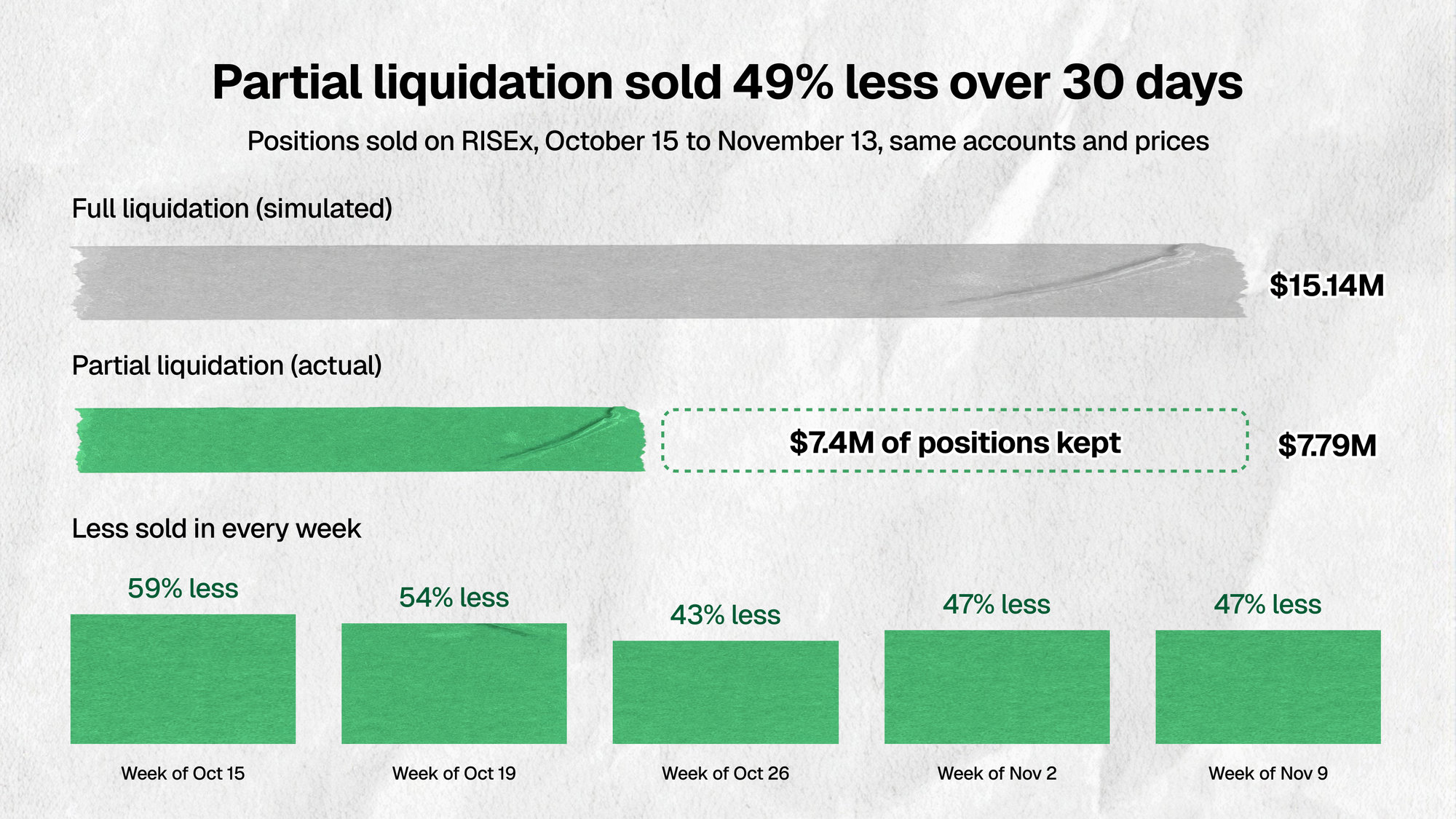
That is about $7.4M of positions RISEx traders still held because the liquidation engine sold only what it had to. They also paid $79K in liquidation fees, whereas the old engine would have charged $156K, since fees follow the amount sold. Of the 1,510 traders liquidated in the window, 106 had less than 10% of their position sold, compared with a full liquidation.
The result held for every week of the window. Partial liquidation sold between 43% and 59% less each week. Savings were smallest in the sell-off weeks, when prices kept falling after the first cut and the system came back for more, as it is built to: 43% less in the week of October 26 and 47% less in the week of November 2.
In early November, a 10x short on ZEC worth about $134K took two small cuts and closed $3,666 up. If fully liquidated, the same trade would have been a $5,658 loss.
What partial liquidation does not do?
Partial liquidation does not make a liquidation less likely. Both systems step in at the same moment, when an account first falls below maintenance margin. The only thing that changes is how much gets sold.
A market that keeps going will still take the position. The system returns every time the account slips under, and repeated cuts can end up selling it all. For 122 of the 1,510 traders, a run of small cuts added up to more than one early full sale, $334K between them.
The $7.4M is also not money paid to anyone. It is the value of positions traders still held because they didn't sell. A kept position can rise, fall, or be liquidated later. The Brent trade worked out, and plenty of kept positions will not.
When you are right but too early
A liquidation on RISEx is now a smaller event. You pay the fee on a slice of the position and keep most of your exposure through the move. That matters most on trades that are right but early, which is where full liquidation did the most damage.
It also changes what a liquidation tells you. A first cut works like a warning with a cost attached. You still have the position and a choice to make: add margin, reduce size, or close. Under full liquidation, there was nothing left to decide.The habits around it stay the same. Position sizing, spare margin and stop losses are still what keep an account away from the line. Partial liquidation is what happens when they fail, and it now costs less.
Straus needed one $500 chip and a seat. Partial liquidation leaves most traders with a good deal more than that.
Partial Liquidation FAQ
What is the difference between partial and full liquidation?
Full liquidation sells an entire position as soon as the account falls below maintenance margin. Partial liquidation sells a slice, enough to make the account safe again, and returns only if the account falls below a second time.
How much of a position does RISEx sell in a partial liquidation?
RISEx sells enough to bring the account back to 1.05 times the maintenance margin. If the same account falls below again within 60 blocks, the next cut targets 1.10 times the maintenance margin, then 1.20, then 1.50.
Can a position still be fully liquidated on RISEx?
Yes. If the market keeps moving against a position, partial liquidation repeats and can end up selling it all.
Does partial liquidation reduce liquidation fees?
Yes. Liquidation fees are charged on the amount sold, so a smaller sale means a smaller fee. Over the 30 days measured, RISEx traders paid $79K in liquidation fees, whereas full liquidation would have charged $156K.
When did RISEx switch to partial liquidation?
RISEx switched to partial liquidation on October 14, 2026. A first trial on October 5 sold enough to lift an account to 1.50 times the maintenance margin, and the stepped version replaced it.
Which RISEx markets does partial liquidation cover?
Partial liquidation applies to cross and isolated positions. The positions in this data included crypto, stocks, silver and Brent oil.