
Five central banks and Big Tech earnings follow last week's AI selloff
Five central banks decide between Tuesday and Friday, and Alphabet, Microsoft and Amazon report in the same stretch. After last Thursday's 6.7% drop in the Philadelphia Semiconductor Index, their capex guidance is the first test of whether that move extends or reverses.

As always, this is not financial advice. This is a research piece, not investment guidance; always do your own research before trading.
The five decisions
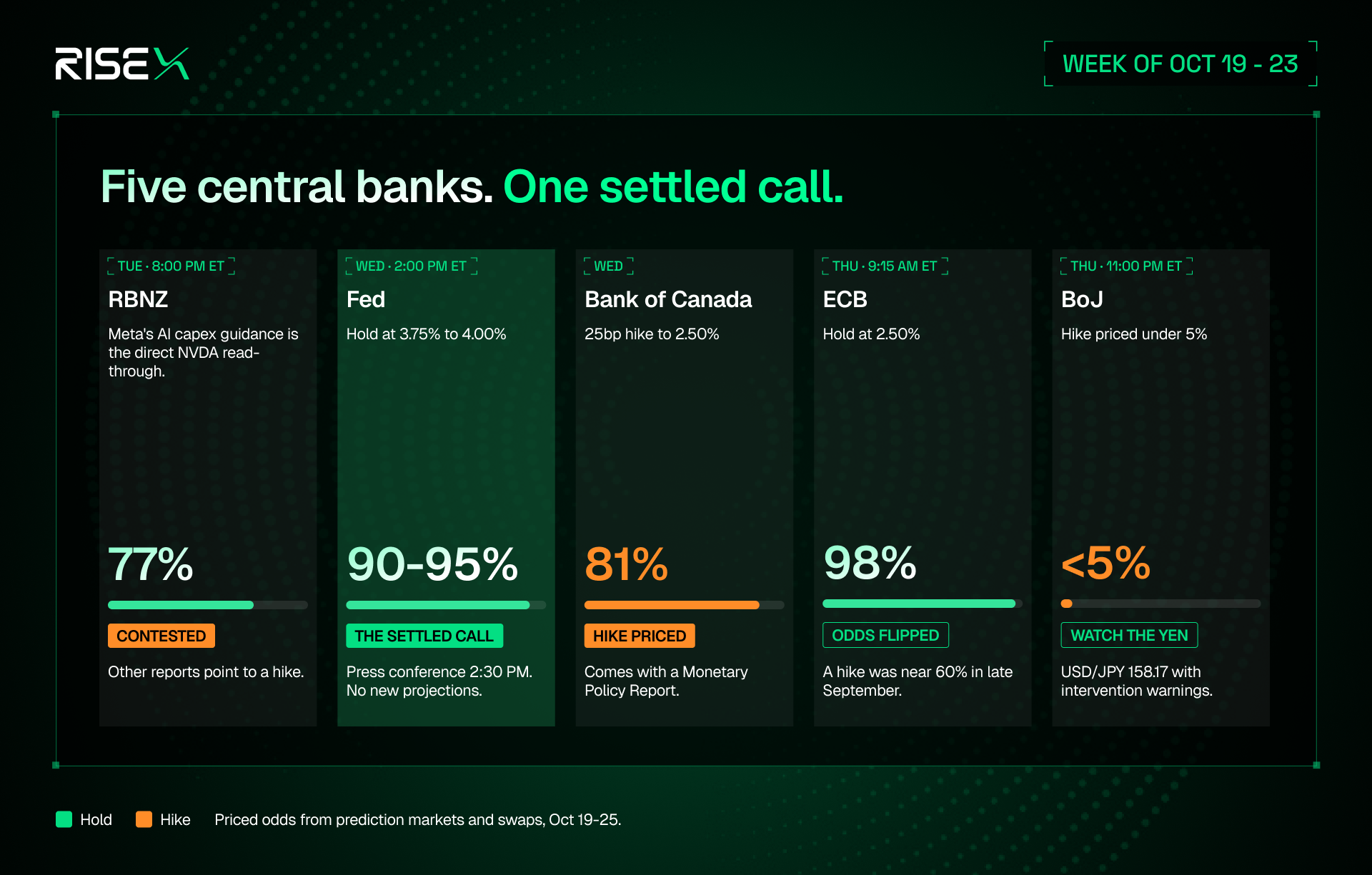
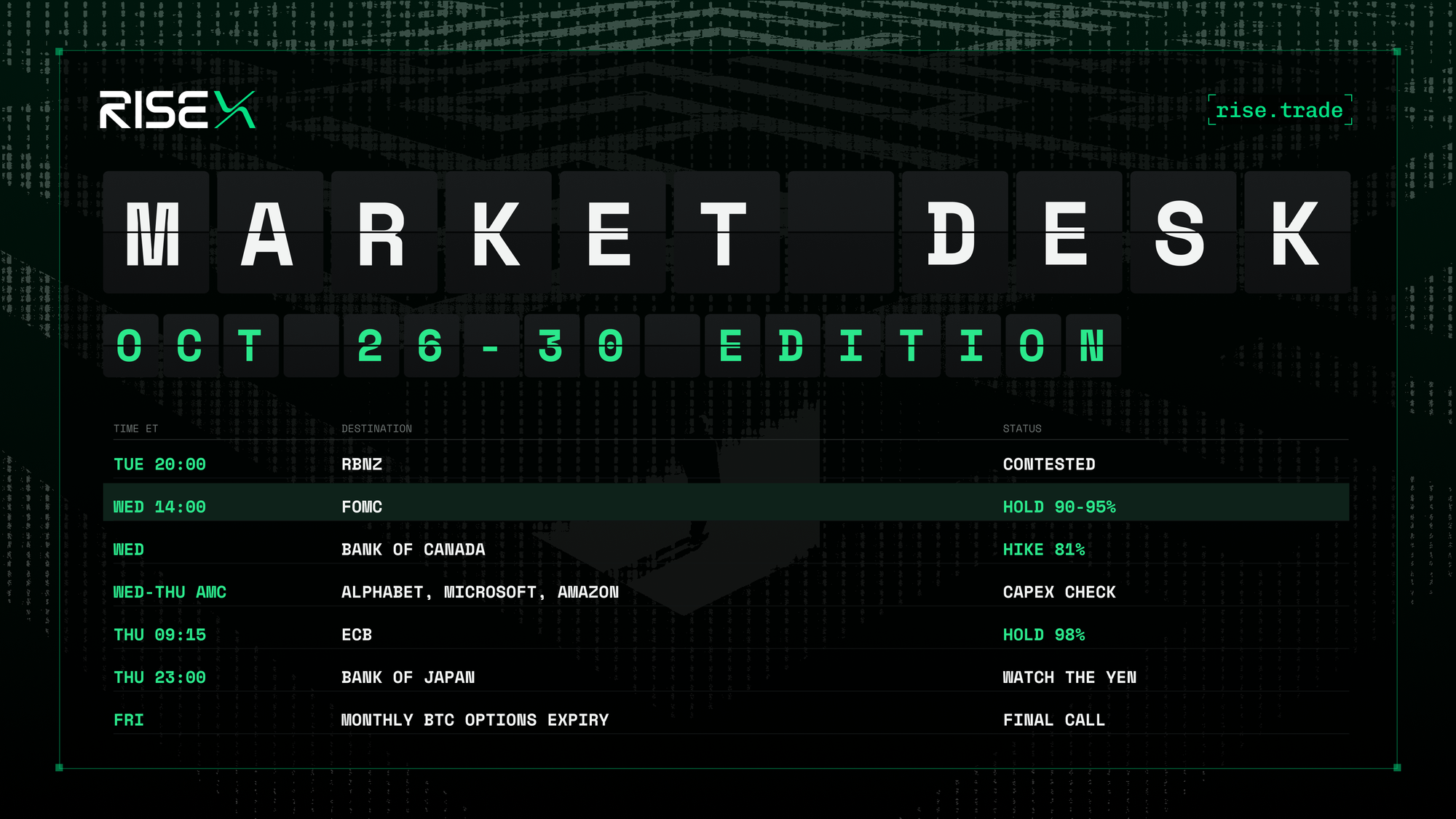
The Reserve Bank of New Zealand decides Tuesday at 8:00pm ET. Kalshi priced a hold near 77% on October 25, with a hike of 1bp to 25bp near 25%, but other reports point toward a hike, so the call is open.
The Fed decides Wednesday at 2:00pm ET. A hold at 3.75% to 4.00% is priced at roughly 90% to 95%, and a December 9 hike at roughly 80% to 90%. The press conference follows at 2:30pm, with no Summary of Economic Projections. Chair Kevin Warsh has stopped giving forward guidance, so the press conference is the main chance for the tone to shift. Thursday's Q3 GDP and September core PCE land after the decision and mainly shape December expectations.
The Bank of Canada also decides Wednesday. A 25bp hike to 2.50% is priced near 81%, and the decision comes with a Monetary Policy Report.
The ECB decides Thursday at 9:15am ET. A hold at 2.50% is priced near 98%, against about 60% odds of a hike to 2.75% in late September.
The Bank of Japan decides Friday at 12:00pm JST (11:00pm ET Thursday). Swaps priced under 5% odds of a hike to 1.50% as of October 19, with a December 18 hike near 80%. USD/JPY traded at 158.17 on October 20, and Japanese officials keep repeating verbal intervention warnings.
The Fed is the only settled call. New Zealand is open, Canada is priced for a hike and the ECB's odds swung without a clear cause, so surprises are likelier from the smaller banks.
Metals fall to fresh lows while oil climbs
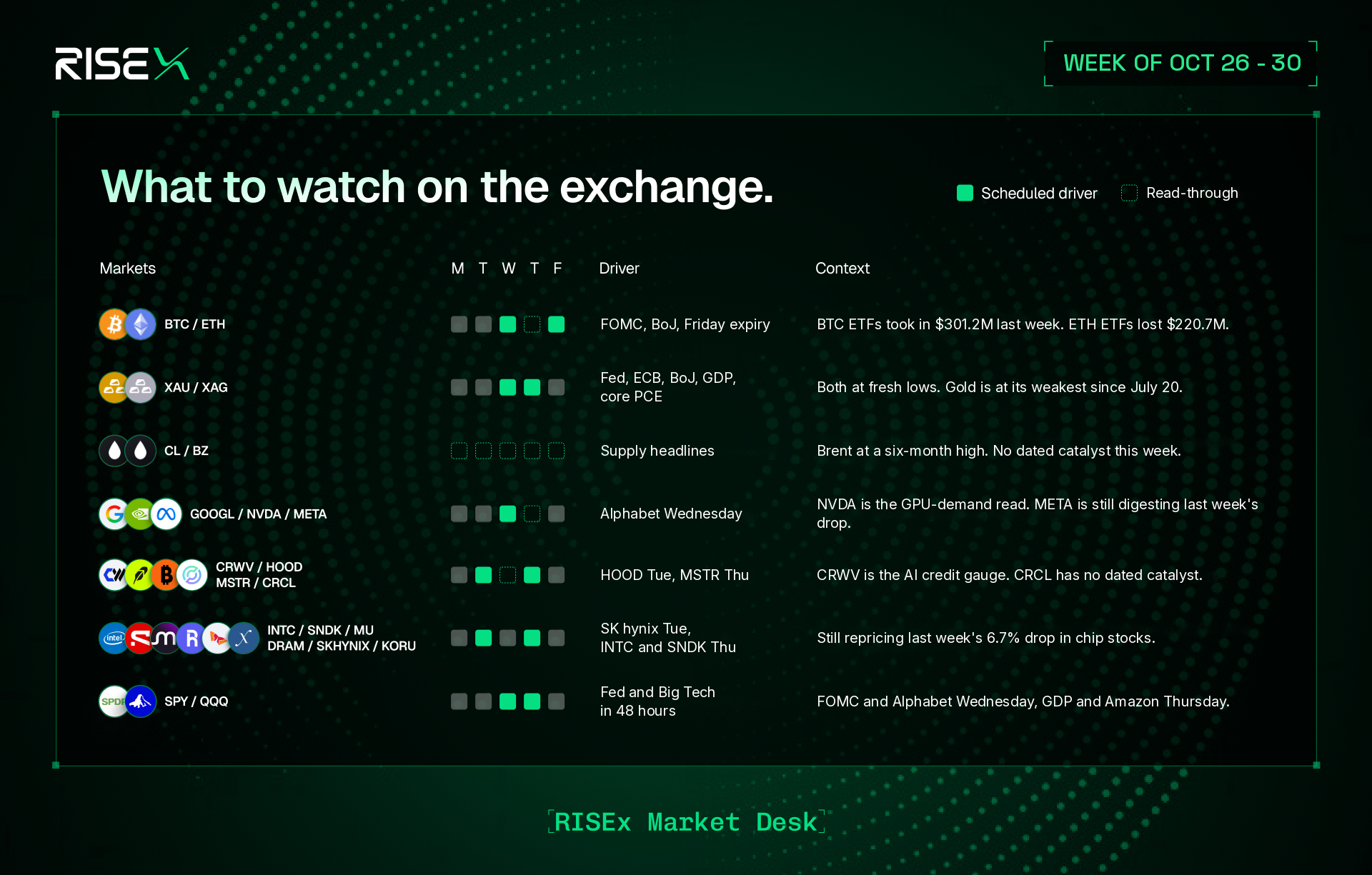
The 10-year Treasury yield sits near 5.00% and the dollar index near 101.6. Gold closed Friday near $3,995.81, down almost 4% on the week and 6.6% on the month, its weakest since July 20. Silver closed near $53.90, its first close below $54 this year, after a 5.8% drop on Thursday. XAU trades at $3,994.83 and XAG at $53.78 on RISEx.
Brent settled at $116.72 on October 23, up 3.14% and its highest since April 29, with WTI near $102.53 to $103.27. No OPEC+ data release is on this week's calendar, so supply headlines stay the driver. CL trades at $103.16 and BZ at $111.39 on RISEx, a little below Friday's external closes.
Metals are weak with yields near 5.00% and a firm dollar. Wednesday's Fed is the first event that can change that. Oil has no dated catalyst, so headlines will move it.
Big Tech earnings re-test last Thursday's drop
On October 22 the Nasdaq Composite fell 2.60% to 26,008.86, its steepest drop since early June, and the Philadelphia Semiconductor Index fell 6.7%, its biggest since June 23. Meta fell about 7% despite beating estimates, after its first negative free cash flow in more than a decade and a 2-for-1 split of its non-voting shares. Tesla fell 3.1%, and Intel, AMD, SanDisk and Marvell each fell more than 8%.
Four reports on that theme land within five trading days of the drop.
- Alphabet reports Wednesday after the close. Call at 4:30pm ET. Watch Search, YouTube ads, Google Cloud and AI infrastructure capex.
- Microsoft reports Wednesday after the close. Fiscal Q1 2027, call at 5:30pm ET. Watch Azure growth and data-center capex.
- Amazon reports Thursday after the close. Call at 5:00pm ET, after guidance of $197B to $202B in Q3 net sales and $22.5B to $26.5B in operating income. Watch AWS growth and capex's effect on free cash flow.
- Intel reports Thursday after the close, with SanDisk the same day. Together they give the memory and chip names two direct reads. SK hynix publishes first, before 9:00am Seoul time Wednesday, which is Tuesday evening in New York.
CoreWeave's bonds are the credit gauge. Its 9.75% notes due 2031 traded near 80.6 cents on the dollar on October 20, a 15.58% yield against about 11.3% in mid-August, and the stock touched a 52-week low of $57.24. It also announced a $3B convertible note offering and an at-the-market program for up to 35M shares. CRWV trades at $54.54 on RISEx. Capex guidance from Alphabet, Microsoft and Amazon is the nearest read-through.
Robinhood and MSTR also report. Robinhood reports Tuesday after the close with a call at 5:00pm ET, with net deposits and Gold subscriber attach to watch. MSTR reports Thursday after the close, and its result mostly follows the value of its bitcoin holdings.
Last Thursday's drop was a reaction to AI spending. Capex guidance from Alphabet, Microsoft and Amazon shows whether the worry spreads or eases, and CoreWeave's bond yield is one place stress would show.
Crypto: ETF flows and a monthly expiry
BTC spot ETFs took in a net $301.2M for October 19 to 23 on provisional data, even after a $635.6M outflow Thursday, the largest since June 25. ETH spot ETFs saw net outflows of $220.7M. BTC traded near $81,000 to $81,500 Friday. On RISEx, BTC trades at $80,451.30 and ETH at $2,336.22.
Friday brings the monthly Deribit expiry. An October 8 report put roughly 35% of Deribit's BTC open interest, about $10.7B to $11.3B notional, on October 30, with max pain near $78,000 to $79,000. The report is three weeks old, so its max pain range may be out of date.
BTC ETF demand held up despite a large Thursday outflow, while ETH weakened. Friday's expiry can add short-term swings, but its open interest data is three weeks old.
The week, day by day
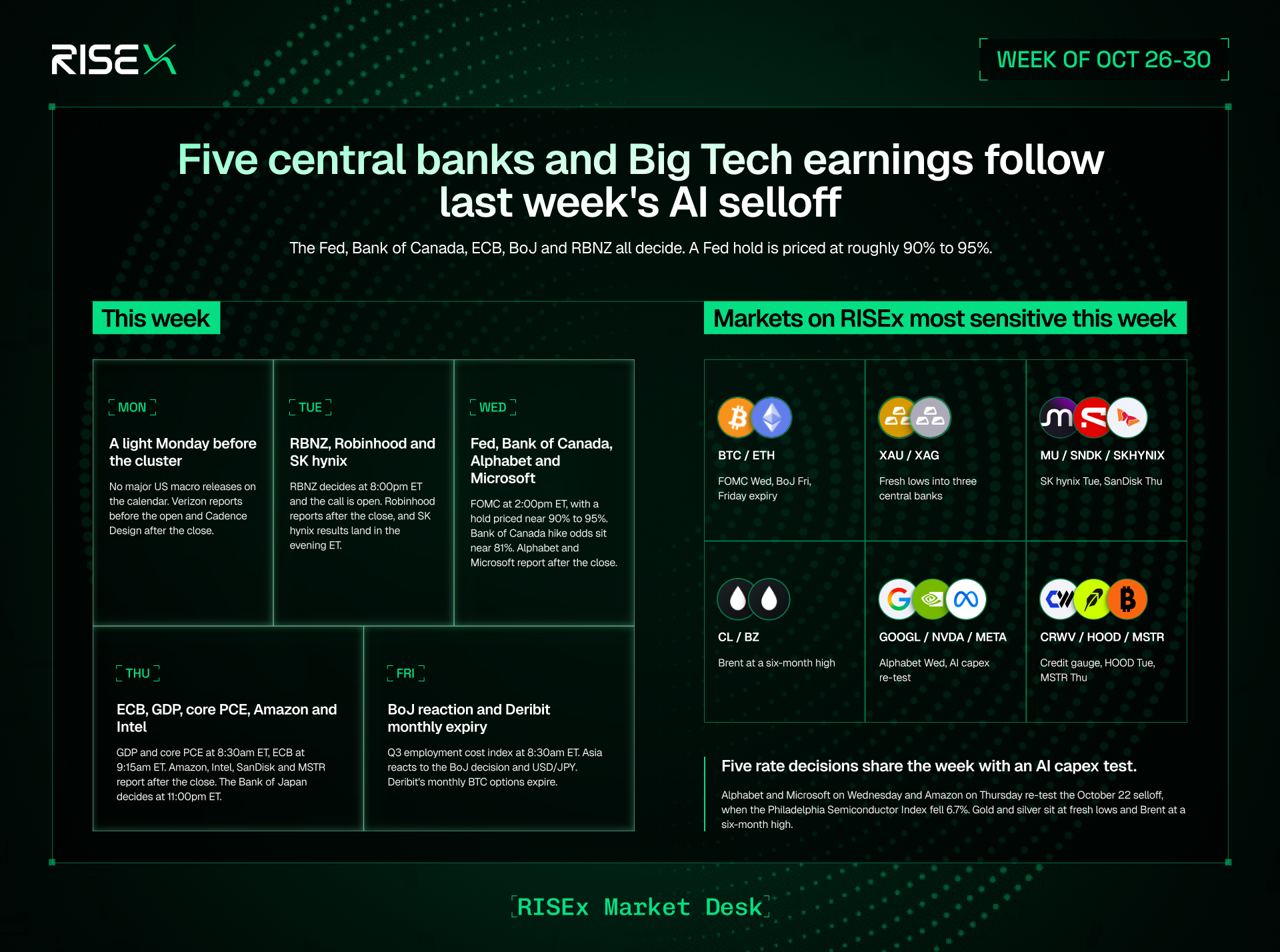
- Monday, October 26: a light day, with no major US macro releases on the calendar.
- Tuesday, October 27: RBNZ at 8:00pm ET, Robinhood after the close and SK hynix results in US evening hours. Durable goods, new home sales and the Richmond Fed index also print.
- Wednesday, October 28: FOMC at 2:00pm ET and the Bank of Canada, then Alphabet and Microsoft after the close.
- Thursday, October 29: GDP, core PCE and jobless claims at 8:30am ET, the ECB at 9:15am ET, Amazon, Intel, SanDisk and MSTR after the close and the Bank of Japan at 11:00pm ET.
- Friday, October 30: Employment cost index at 8:30am ET and Fed speakers Mary Daly and Alberto Musalem, the Bank of Japan reaction in Asia and Deribit's monthly expiry.
What to watch on the exchange
FAQ
Is the Fed expected to change rates on October 28?
No. A hold at 3.75% to 4.00% is priced at roughly 90% to 95%.
Which central banks decide this week?
New Zealand on Tuesday, the Fed and Bank of Canada on Wednesday, the ECB on Thursday and the Bank of Japan on Friday morning Tokyo time.
When do Alphabet, Microsoft and Amazon report?
Alphabet and Microsoft on Wednesday after the close, Amazon on Thursday after the close.
Why did semiconductor stocks fall last Thursday?
Heavier AI capex disclosures from Meta and Tesla sent the Philadelphia Semiconductor Index down 6.7%. Meta also posted its first negative free cash flow in more than a decade.
What happened to bitcoin ETF flows last week?
BTC spot ETFs took in a net $301.2M on provisional data, while ETH spot ETFs saw net outflows of $220.7M.
What time is the Bank of Japan decision in US time?
11:00pm ET on Thursday, October 29, which is 12:00pm JST on Friday.