
RISE Launch philosophy

RISE is going live. We're doing it differently.
I've been talking about onchain orderbooks for years. Ask anyone on the team. Ask anyone who's sat through a pitch with me. At some point in every conversation, I end up back at the same place: the orderbook needs to live onchain, natively, in the EVM. Not offchain matching with onchain settlement. Not a two-layer system where the orderbook and smart contracts communicate via precompiles. Actually onchain. In the same execution environment as everything else.
Honestly, for a long time, the infrastructure didn't exist to do it at the speed real markets demand. You could put an orderbook onchain, but it would be slow, expensive, and nobody serious would trade on it. So the industry compromised. AMMs became the standard, not because they're better for price discovery, but because they were the best we could do with the infrastructure we had. Offchain matching became the shortcut for anyone who wanted real performance.
We didn’t think that was the way to go, so we spent the time building the infrastructure that makes a fully on-chain orderbook actually competitive.
The performance
Testing ahead of the launch, we're hitting 5 Ggas/s with 50k TPS. 1ms orderbook updates. The execution cost of running all of this onchain is enormous. RISE, in private beta, is now burning more gas than Ethereum and all the L2s combined
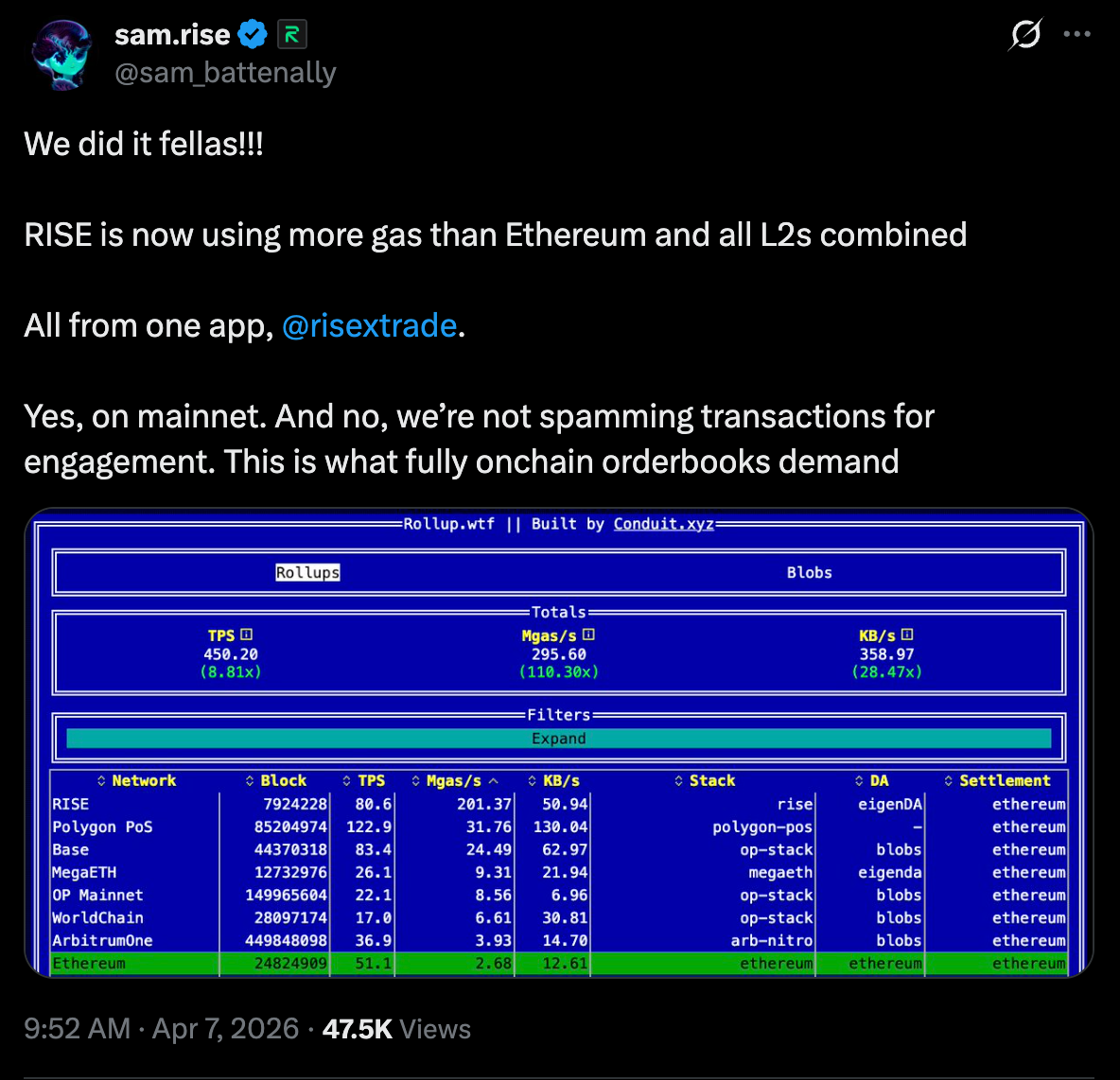
Despite popular belief, blockspace was the bottleneck. Orderbooks weren't possible on-chain due to throughput and gas limitations. Now they are, thanks to RISE. The sheer amount of gas we're using to make markets on a high-quality exchange demonstrates that.
That's what RISE was built for. Not to be another L2. To be the chain where a orderbook can finally run on-chain at the speed it needs to support the needs of liquid markets.
And now we're here. Both RISE chain and RISEx are live. They have been for a few weeks, in fact... But they're invite-only.
Why invite-only
I've seen what happens when you launch before the product is ready. Projects announce a mainnet date, promote it everywhere, then spend three months firefighting while their community battles with issues.
The chain isn't the product, that apps are.
Our first users are carefully selected. They're traders, power users and our most active community members. People who care about what we've built, not just what they can farm. These are the people who will help us build a world-class product.
When the time comes we will share more on how you can get access to try RISEx for yourself.
So what does RISEx unlock for you as a trader?
The orderbook and everything else on the chain share state. Same block, same transaction. This isn't a technical detail. It's the reason everything works the way it does. There are other exciting updates coming shortly after this invite-only phase.
AutoYield will exist because idle margin can be routed to yield sources and returned atomically. There's no bridge between the orderbook and the lending market. They're one system. Your margin earns while you trade, managed by Yearn, no lock-up.
Permissionless Portfolio Margin will exist because Morpho and RISEx share a single EVM state. Anything can effectively serve as collateral because lending protocols can read your positions within the same execution context. Your positions offset each other. Less margin locked, more capital free.
You can deposit multiple asset types as collateral. No forced conversion into a single token before you trade. And the orderbook updates every millisecond.
Final thoughts
The contracts were completely rewritten in December to support all of this. Audited by Spearbit and yAudit. AutoYield vaults managed by Yearn. Money markets, Morpho contracts, managed by Spine, and liquidations supported by Icarus. Fully onchain basis trade vaults with atomic composability built by Shift Protocol. There are a lot of moving parts, and we intend to polish them.
I know the market is crowded. We're not trying to be the loudest. We're trying to be the best. That starts with proving the product works with real users and deep liquidity.